How to Choose the Right Bag for Your Needs
Understanding what’s available is the first step. Choosing the right configuration for your specific application comes down to answering two fundamental questions in order:
Step 1: What size bag do I need?
This is driven by your material’s density and your desired fill weight.
Step 2: What features does that bag need?
This is driven by your material’s particle size, environmental requirements, and handling conditions.
Let’s walk through each step systematically so you can specify the right FIBC for your application.
Step 1: Determine Your Bag Size (Density-Driven)
Before you can select any bag features, you need to know what size bag you’re working with. Bag size is determined by a simple equation: fill weight ÷ bulk density = required bag volume.
Understanding Material Density
Density is how much your material weighs per unit of volume, typically measured in pounds per cubic foot (lbs/ft³) or kilograms per cubic meter (kg/m³). This single number determines the entire physical geometry of your bulk bag.
Why density is the foundation of bag sizing:
A 2,000-pound bag means completely different things for different materials:
- Light material (fumed silica at 4 lbs/ft³): Requires 500 cubic feet of volume—that’s a massive bag roughly 6 feet in diameter and 8+ feet tall
- Medium material (flour at 30 lbs/ft³): Requires 67 cubic feet—a standard 42″ x 42″ x 48″ bag
- Dense material (sand at 100 lbs/ft³): Requires only 20 cubic feet—a compact 35″ x 35″ x 36″ bag
These are the same weight, but require completely different bag dimensions. This is why you must know your material density before you can specify anything else.
Calculating Your Required Bag Size
Methods to determine your material’s bulk density:
- Check material specifications from your supplier
- Measure the material yourself by weighing a known volume
- Send samples to Formpak Group for free density testing
Note: Some materials have variable density depending on compaction—these materials must be tested in actual handling conditions. FormPak offers free material testing.
1) Decide on target fill weight
- What weight per bag optimizes your handling equipment?
- What weight can your operators safely manage?
- What fits your storage and transport logistics?
- Typical range: 500 lbs to 4,000 lbs per bag
2) Calculate required volume
Required volume (ft³) = Fill weight (lbs) ÷ Bulk density (lbs/ft³)
Example:
- Material: Plastic pellets
- Bulk density: 40 lbs/ft³
- Desired fill weight: 2,000 lbs
- Required volume: 2,000 ÷ 40 = 50 cubic feet
3) Match to standard bag dimensions
A 50 cubic foot bag translates to approximately:
- 42″ x 42″ x 48″ tall (standard size)
- Or 38″ x 38″ x 54″ tall (taller, narrower profile)
- Or 45″ x 45″ x 42″ tall (shorter, wider profile)
4) Match to standard bag dimensions
A 50 cubic foot bag translates to approximately:
- 42″ x 42″ x 48″ tall (standard size)
- Or 38″ x 38″ x 54″ tall (taller, narrower profile)
- Or 45″ x 45″ x 42″ tall (shorter, wider profile)
Common Bag Sizes and Capacity Ranges
Understanding standard bag dimensions helps you work within economical options:
Small bags (35″ x 35″):
- Volume: ~25-35 cubic feet
- Typical capacity: 500-1,500 lbs depending on density
- Good for: Tight spaces, manual handling, smaller batch sizes
Standard bags (42″ x 42″):
- Volume: ~40-60 cubic feet depending on height
- Typical capacity: 1,500-3,000 lbs for most materials
- Good for: Most industrial applications, balance of capacity and handling
Large bags (48″ x 48″):
- Volume: ~65-85 cubic feet depending on height
- Typical capacity: 2,500-4,000+ lbs for most materials
- Good for: High-volume operations, minimizing bag changes
Operator Ergonomics and Size Restrictions
Bag height isn’t just about facility clearances—it’s also about operator accessibility and workflow efficiency.
Reach height considerations:
Consider the total working height when bags are positioned on equipment. Your operators will have to reach the top of the bag to open it for filling and access the bottom of the bag for discharging.
Stacking and storage considerations:
Shorter bags are safer to handle and easier to stack, along with improving ergonomics for your operators.
Important: Always verify that your selected bag dimensions work within your facility constraints (ceiling heights, door widths, storage areas) AND with your handling equipment (hoist capacities, forklift clearances) AND provide reasonable operator access for your workflow AND optimize your logistics costs.
Transportation optimization
Bag dimensions significantly impact logistics costs and efficiency. Standard truck and container dimensions should influence your bag size selection.
Standard truck trailer interior width: 96-102 inches
This creates clear optimization opportunities for bag width selection:
48” x 48″ bags are perfect for freight transportation:
- 2 bags side-by-side = 96″ (exactly fills standard trailer width)
- Maximum utilization of truck space
- Higher capacity per shipment
- May require more careful loading to avoid width issues
Step 2: Select Bag Features (Particle Size and Requirements-Driven)
Now that you know what size bag you need, it’s time to specify the construction features. This is where your material’s particle size becomes critical, along with other application requirements like moisture sensitivity, safety certifications, and handling conditions.
Understanding Particle Size Impact on Bag Construction
Particle size determines whether your material will stay contained in the bag or whether it will sift through the fabric weave, migrate through seams, or create dust issues.
Critical Note on Ultra-Fine Powders:
Materials under 50 microns (like fumed silica, titanium dioxide, or fine pharmaceutical powders) are fundamentally different from standard fine powders like flour. These ultra-fine particles are so small they can:
- Migrate through standard fabric weave even when coated
- Seep through seams and stitching holes that would contain flour
- Create significant dust and product loss without proper containment
- Require specialized sift-proof construction with reinforced seams
Liner and Coating Requirements
Liners serve three primary purposes: moisture protection, atmosphere control, and particle containment.
- Fabric coatings are a good idea if your material is under 200 microns
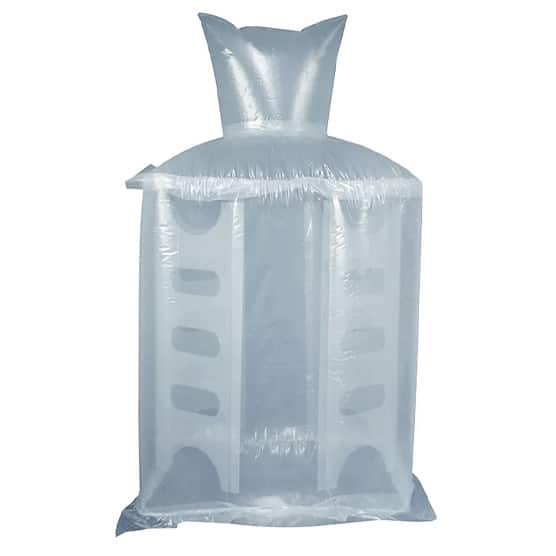
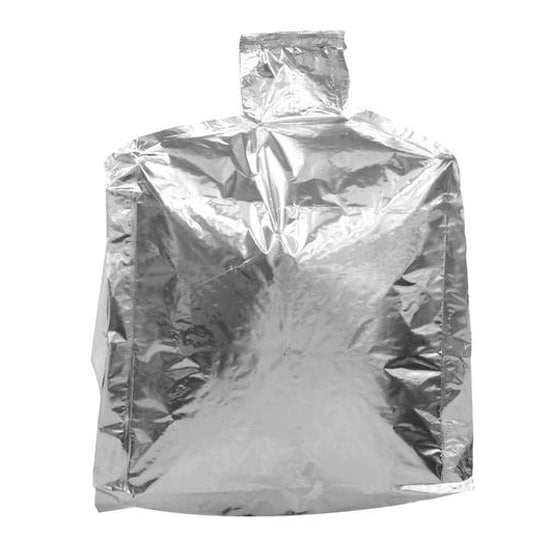
- Foilized liners are like the inside of a chip bag. It’s the only type of liner that prevents airflow completely. This is useful for sensitive or perishable materials.
- Polyethylene liners are commonly used in food applications for material containment purposes.
- Sift-proof seams is critical for any material under 50 microns
When you can skip the liner:
- Material is coarse (over 500 microns) and not moisture-sensitive
- Coated fabric provides adequate particle containment
- Environmental conditions are controlled
- Cost reduction is priority
- Bag will be disposed after single use anyway
Ready to Select Your Optimal Bulk Bag?
Don’t guess at FIBC specifications. Let Formpak Group’s bulk bag experts guide you through the selection process.
Contact us today for a free material review and bulk bag recommendation.
With 58 years of material handling expertise and deep FIBC knowledge, Formpak Group ensures you get bulk bags that are properly sized for your material’s density, properly constructed for your particle size, competitively priced, and proven to perform.
Formpak Group uniquely integrates FIBC packaging expertise with engineered handling systems—from bags to automation. Our modular, future-ready solutions are built on reliability, safety, and partnership, making us your end-to-end dry material handling partner.